




High-Performance 200gsm Twill Basalt Fiber: The Future of Drone Frame Composites
In the drone community, carbon fiber has long been regarded as the "black gold" standard. However, if you are tired of exorbitant costs, severe GPS signal interference, or frame arms that shatter into dust upon impact, then the "power of volcanic rock"—Basalt Fiber—is quietly changing the rules of the game.
In particular, 200gsm twill basalt fiber fabric is not merely a direct substitute for carbon fiber; it represents a pivotal step in the evolution of frames for small to medium-sized drones.
What is Basalt Fiber? The "AlChemical" High-Tech Material
Simply put, basalt fiber is created by feeding natural basalt ore into a high-temperature furnace—reaching temperatures of up to 1500°C—melting it down, and then drawing it out into extremely fine filaments. This process requires no chemical additives and is hailed within the industry as a "green industry" that effectively turns stone into gold.
Compared to fiberglass, it is stronger and stiffer; compared to carbon fiber, it offers superior impact resistance while remaining incredibly affordable.
Why is 200gsm Twill Fabric the "Golden Specification"?
For drone frames—particularly those in the 5-inch or 7-inch class—material specifications are paramount.
The Balance of 200gsm: This specific weight offers the perfect strength-to-weight ratio. Too light, and the material lacks sufficient stiffness; too heavy, and the drone becomes a "flying brick." The 200gsm weight strikes the ideal balance, ensuring that the frame arms remain lightweight while possessing ample torsional rigidity.
The Magic of 2/2 Twill: The twill weave is inherently more "drapable" than a plain weave. When laying up layers over complex frame contours—such as corners and curves—twill fabric conforms tightly to the mold like a second skin, without wrinkling. Furthermore, the linear alignment of fibers within the twill structure allows for more efficient absorption of impact energy.
Which "Pain Points" of Carbon Fiber Does It Solve?
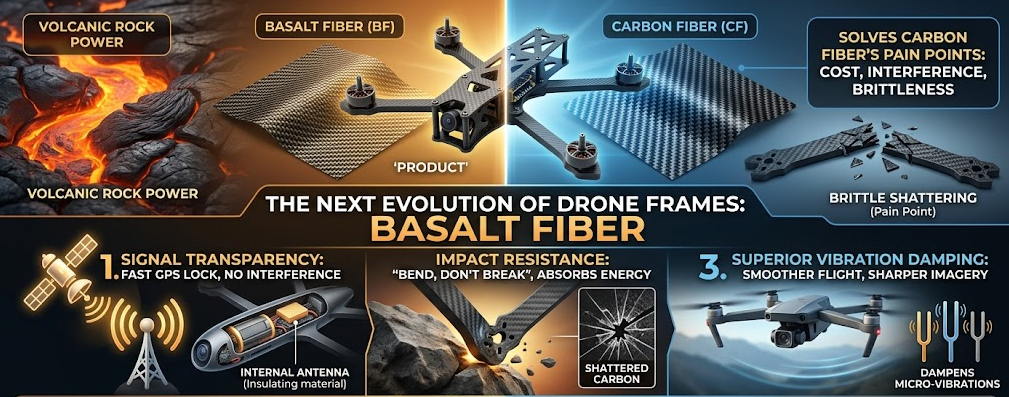
1. Signal Transparency: No More "Struggling to Lock GPS"
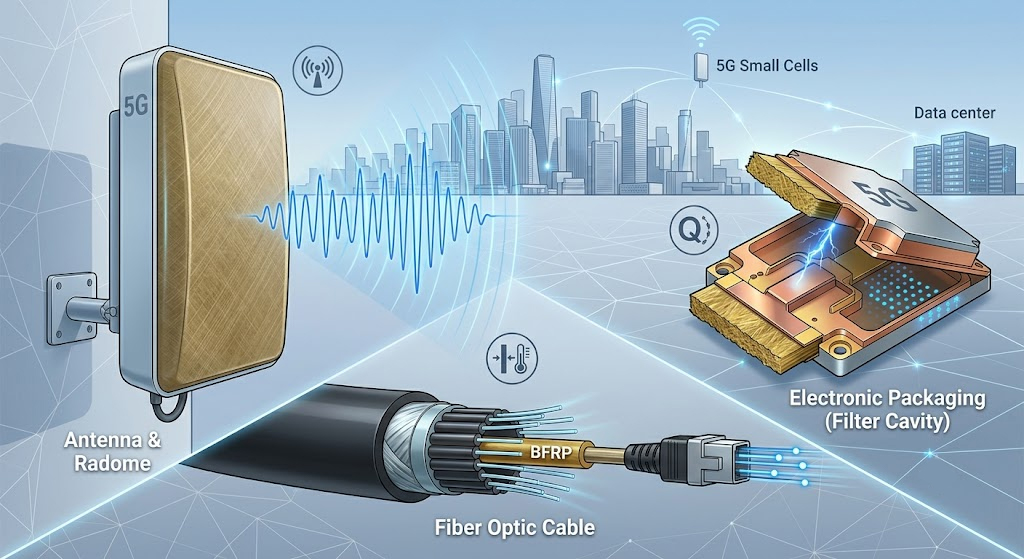
Carbon fiber is electrically conductive; it essentially acts as an electromagnetic shield, reflecting radio signals. Many drone enthusiasts, seeking faster GPS satellite acquisition, are forced to mount their antennas high above the airframe. Basalt fiber, however, is an electrical insulator—a "wave-transparent" material. This means you can conceal antennas, 5G modules, and even radar systems directly inside the fuselage, resulting in a cleaner aesthetic without compromising signal strength.
2. Impact Resistance: It "Bends, But Does Not Break"
While carbon fiber is rigid, it is also brittle. During a high-speed crash, carbon fiber arms often snap cleanly across their cross-section. Basalt fiber boasts a higher elongation at break (approximately 3.1%), granting it superior resilience when subjected to impact. Rather than shattering like glass, it tends to absorb energy through deformation—a critical attribute for safeguarding the expensive flight control electronics housed within the airframe.
3. The Master of Vibration Damping
Minute vibrations generated by motors are the nemesis of high-definition aerial photography. Basalt fiber naturally possesses exceptional damping characteristics. Much like a tuning fork, it absorbs high-frequency vibrations, ensuring smoother flight operations and delivering sharper, clearer imagery.
Performance Comparison: Basalt vs. Carbon Fiber vs. Fiberglass
| Dimension | Basalt Fiber (BF) | Carbon Fiber (CF) | E-Glass Fiber (GF) |
| Tensile Strength | Very High (3000-4840 MPa) | Highest (3500-7000+ MPa) | Moderate (2000-3500 MPa) |
| Elastic Modulus | Excellent (10%-25% higher than GF) | Ultra-High (230-600+ GPa) | Lower (Approx. 72 GPa) |
| Signal Transparency | Perfect (Insulating, High Wave Transmittance) | Shielding (Conductive, Blocks Signals) | Good (Insulating) |
| Heat Resistance | Excellent (-260°C to 700°C) | Moderate (Oxidizes at high temps, resin-dependent) | Fair (Max temp approx. 450-600°C) |
| Chemical Resistance | Highly stable in strong acid/alkali environments | Excellent | Susceptible to acid/alkali erosion |
| Eco-Friendliness | Natural stone melt, 100% recyclable | High production energy, difficult to recycle | Production involves emission pressures |
Conclusion: The Next Step for Drone Enthusiasts
If you are seeking a material that simultaneously enhances frame durability, eliminates signal interference, and keeps costs within a reasonable budget, 200gsm twill-weave basalt fiber is the answer.
It is not merely a novel material confined to the laboratory; it is a mature solution already ready for large-scale application. Whether for DIY FPV racing drones or industrial inspection platforms, this fiber—born from volcanic rock—is defining the structural backbone of the next generation of unmanned aerial vehicles.