



Development of application scenarios for basalt fiber
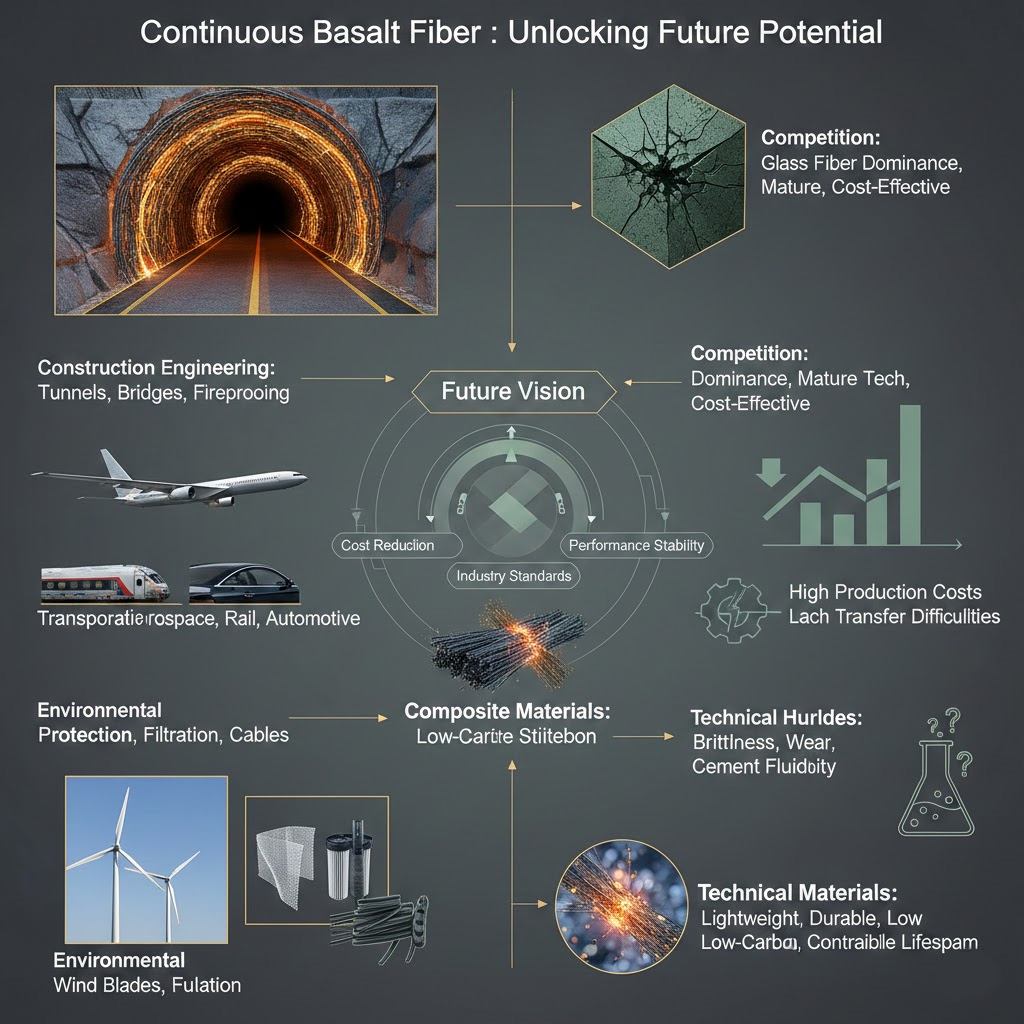
Compared to other high-Performance Fibers,continuous basalt fiberboasts abundant raw material sources, an environmentally friendly production process, and High Strength, modulus, and excellent physicochemical properties. Its main applications include:
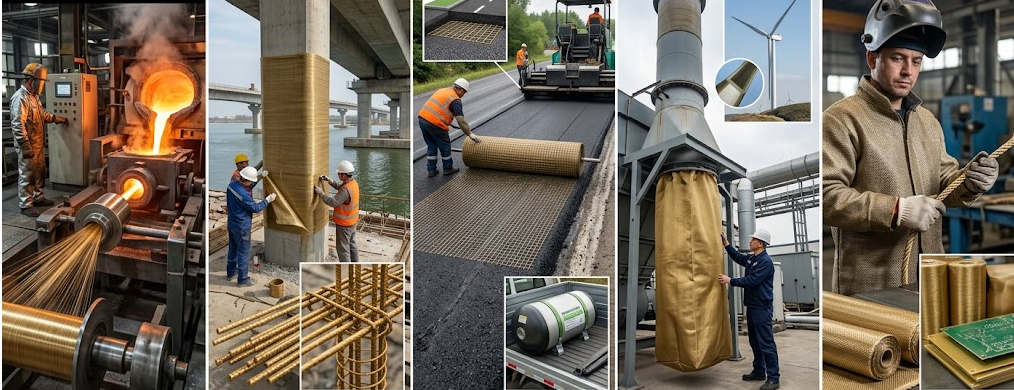
- Construction Engineering:
Used to replace steel reinforcement or glass fiber in reinforcing concrete structures such as tunnels and bridges; also used for fireproofing in flammable and explosive areas, such as in the production of fire-resistant boards and coatings.
- Transportation: Used to compose components for aerospace, rail transportation, and other vehicles; also as interior decorative components.
- Environmental Protection and Energy: Primarily used in industrial wastewater and exhaust gas treatment filtration devices, and in the manufacture of wind turbine blades and insulated cables. It can also be used for pipeline corrosion protection, bulletproof materials, and the production of circuit boards.
Although basalt fiber has good market development potential, its widespread application faces challenges such as a lack of standards, difficulties in technology transfer and application, and high production costs. Glass fiber and basalt fiber are largely substitutes for each other as reinforcing materials. After more than 50 years of development, glass fiber has mature technology, large-scale production, and a complete product series, making it cost-effective and widely used in composite materials. In China, the high-end composite materials market is basically monopolized by high-performance glass fiber and carbon fiber, while the performance of basalt fiber still cannot meet the needs of the high-end market. Regarding alkali resistance, high-zirconium alkali-resistant glass fiber (zirconium dioxide mass fraction above 16.5%) remains the dominant material in fiber-reinforced concrete (GRC), while boron-free corrosion-resistant glass fiber E-CR also hinders the development of acid corrosion resistance. In China, glass fiber almost dominates the composite materials market.
The application market for basalt fiber faces many technical challenges. Continued efforts are needed to reduce production costs, stabilize product performance, and improve industry standards. Basalt fiber is a brittle material with high fiber density and poor wear resistance; further theoretical research is needed on the application and service life of woven fabrics. In the transportation sector, increasing the proportion of basalt fiber reduces the fluidity of cement mortar, leading to unstable concrete performance. These issues urgently require technological breakthroughs. Simultaneously, developing composite fiber materials to meet diverse market demands, and improving the durability, lightweight, low-carbon, damage-controllable, and lifespan-controllable designs of basalt fiber composite materials are currently hot topics in the field of basalt fiber composite material technology research.