

Application of Layered Basalt Ultra-Fine Yarns and Their Fabrics in Lunar Exploration
The research paper titled "Hierarchical basalt metayarn for ergonomic protective space textiles" was published in the journal Matter by the team of Professor Xia Zhigang and Academician Xu Weilin from the National Key Laboratory of New Textile Materials and Advanced Processing at Wuhan Textile University, in collaboration with Professor Tao Guangming. This research group for new textile materials and advanced processing first proposed the core-spun spinning technology "coaxial spiral wrap spinning," which addresses the challenges of non-destructive, low-torque, high-quality, and large-scale spinning, weaving, and application of basalt fiber at the ultrafine scale. This opens up a new pathway for the large-scale, skin-friendly, and flexible textile processing of high-stiffness and high-brittleness inorganic fiber materials, allowing for the mass production to meet the urgent need for high-performance protective materials to withstand complex and extreme environments in the Aerospace field. The first author of the paper is Professor Xia Zhigang, and the corresponding authors are Academician Xu Weilin and Professor Tao Guangming. The paper was selected as a journal cover article.
The application of hierarchical basalt ultrafine yarn and its fabrics in lunar exploration is a critical scenario for future human space migration. This hierarchical basalt ultrafine yarn features flexibility, high strength, and excellent stability, and can be woven into soft fabrics that effectively resist strong solar radiation and extreme temperature fluctuations in space. This research pioneers a new method for transforming brittle inorganic basalt fiber into practical, ergonomically protective space textiles.
In recent years, with the rapid development of global deep space exploration and commercial aerospace, the industry's demand for Lightweight, extreme-environment-resistant materials has sharply increased.Basalt fiber, derived from volcanic rock, possesses prominent advantages such as low cost, high temperature resistance, high thermal insulation, radiation resistance, corrosion resistance, and non-flammability with no smoke, attracting competitive deployment in multiple fields including rail transit, special protection, and civil engineering. However, its inherent high stiffness and high modulus make it highly susceptible to brittle fracture at the ultrafine scale; traditional high-torque spinning also causes fiber damage and a sharp drop in strength, resulting in the achievement of "non-destructive, low-torque, fully covered, skin-friendly, and flexible" high-quality yarn becoming a long-term "bottleneck" problem that restricts basalt fiber from entering the textile application system.
Technology Development Timeline
To solve this technical bottleneck and meet the needs of extreme protection applications, a domestic company collaborated with Professor Xia Zhigang’s team at Wuhan Textile University. They tackled the entire industrial process, from spinning, yarn making, weaving, to dyeing:
-
2019: First proposed non-destructive wrapping spinning.
-
2020: Successfully developed the first skin-friendly basalt fiber thermal protective fabric.
-
2021: Achieved precision-controlled drawing technology for ultrafine basalt fiber used in apparel fabrics.
-
2022: The laboratory successfully designed and spun high-quality, low-torque, non-destructive, fully covered, high-proportion basalt fiber fine yarn.
-
2023: Stable operation of the complete industrial set of processes and equipment suitable for non-destructive, full-coverage spinning of basalt fiber.
-
2023 to Present: Continuous optimization and improvement of processes and equipment, taking orders for production, and developing high-end basalt fiber protective fabrics for extreme protection scenarios.
-
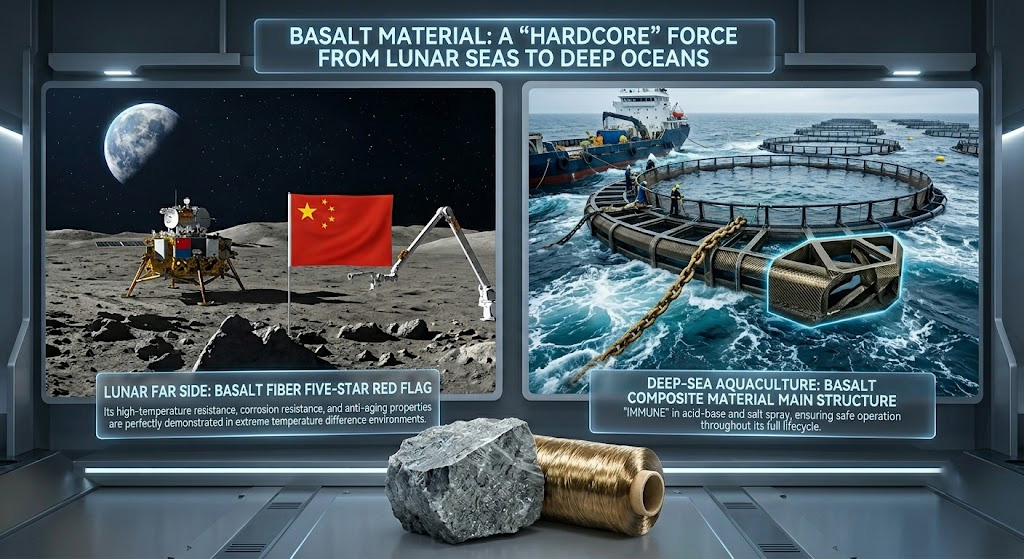
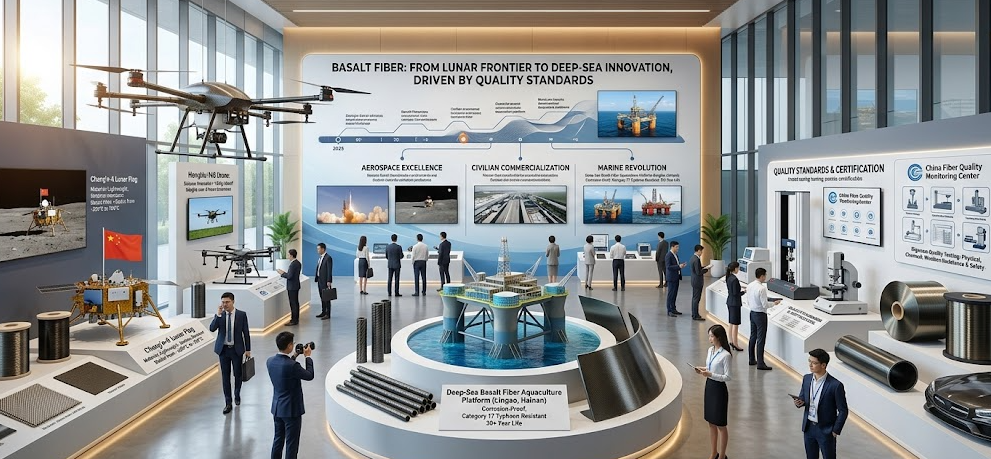
2024: The Chinese national flag made of basalt fiber, developed by Wuhan Textile University, was successfully unfurled on the far side of the Moon by the Chang'e-6 mission, further promoting attention and application expansion of basalt extreme protective fabrics.
-
2025: A "Basalt Fiber Era" innovation team was jointly established by Aero-Engine Corporation of China Hangyu Life Support Equipment Co., Ltd. and Academician Xu Weilin's spinning team at Wuhan Textile University. The team is dedicated to in-depth research and promotion of the full-chain aerospace application expansion of basalt fiber, from raw materials to textile products, addressing international space science frontiers and major national strategic needs.
Innovation and Performance
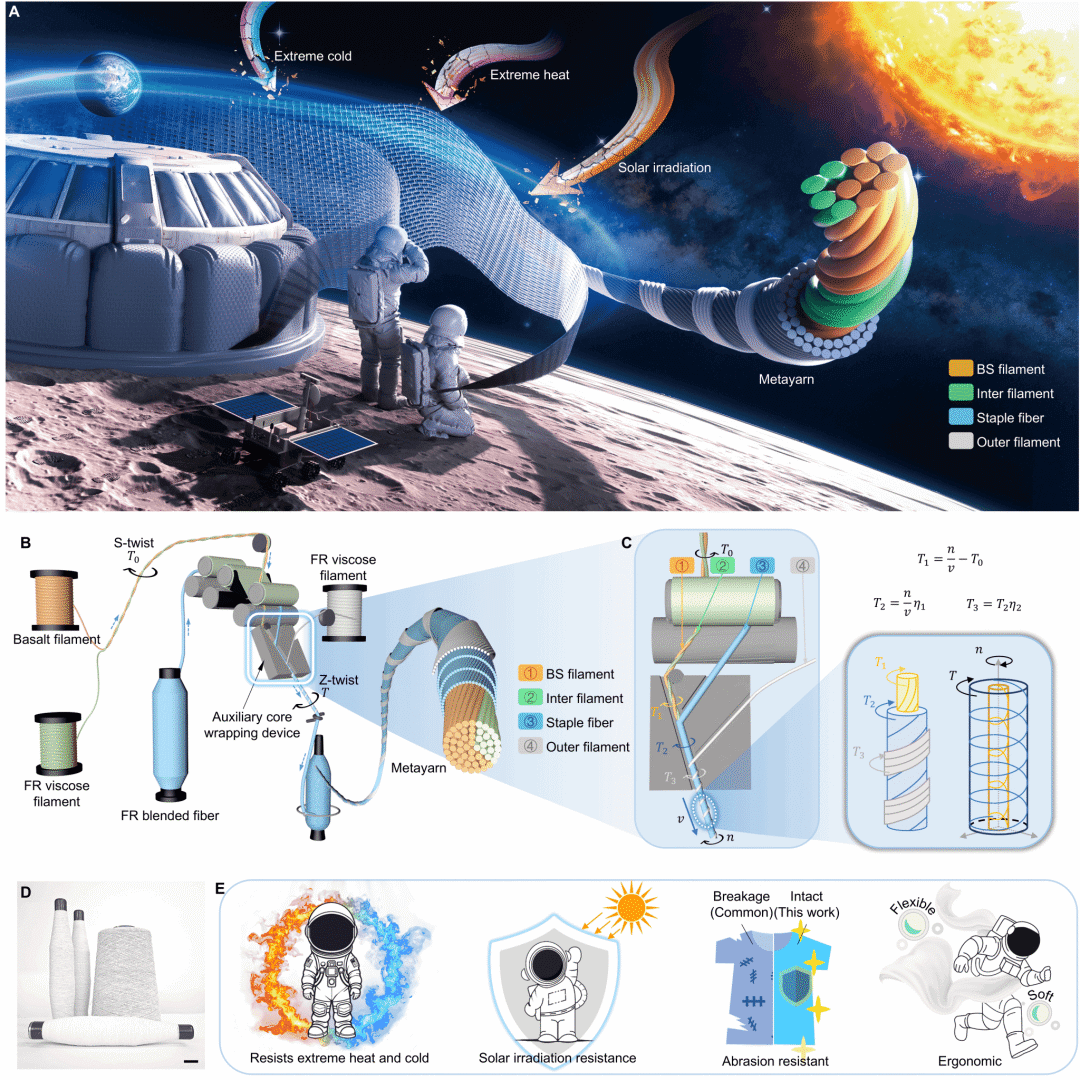
Led by Professors Xu Weilin, Xia Zhigang, and Tao Guangming, along with graduate students such as Shang Lulu, Xu Ao, and Zhang Shiliang, the team continuously innovated and improved current technology. They pioneered the "coaxial spiral wrap spinning" technology, overcoming key technical and equipment innovations such as non-destructive, low-torque yarn formation and multi-level stable coverage.
They achieved industrial-scale, continuous production of multi-level, organic-inorganic composite, skin-friendly, flexible basalt meta-structural yarn (Metayarn).
-
The strength of the produced Metayarn increased by 27.76% compared to the original basalt filament.
-
The residual torque of the yarn was significantly reduced compared to other commercial yarns, allowing for direct knitting or weaving into skin-friendly, flexible Metayarn products.
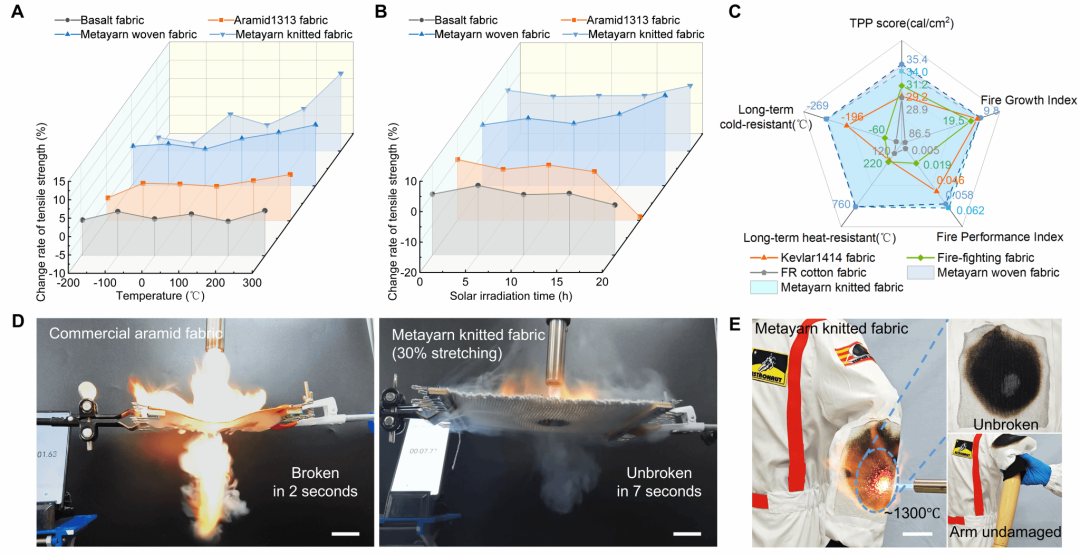
Facing complex and extreme aerospace environments, Metayarn products exhibit outstanding environmental adaptability and structural stability:
-
The flexible product’s strength did not decay, but rather increased, after continuous flushing with liquid nitrogen at 200°C , hot air at 300°C , and prolonged exposure to strong solar radiation.
-
It maintained structural integrity after being scorched by a 1300°C flame.
-
Metayarn knitted products possess an elongation at break of up to 421%.
-
They maintain excellent flame retardancy and fire resistance even under 30%, achieving the integrated function of "comfort and protection."