





Mechanical Properties and Failure Mechanisms of Fiber-Reinforced Concrete: Influence of Fiber Type and Content
Concrete is the most widely used Construction material. It offers numerous advantages, including its widespread availability, simple production process, low cost, and ease of application. It's extensively used in various fields such as buildings, roads, bridges, tunnels, and hydraulic engineering. As a large number of engineering projects have developed, the demands on concrete's performance have also gradually increased. Consequently, the shortcomings of traditional concrete, such as insufficient tensile strength, poor crack resistance, and volume instability, have become apparent. Therefore, improving the performance of concrete has consistently been one of the key research directions in civil engineering.
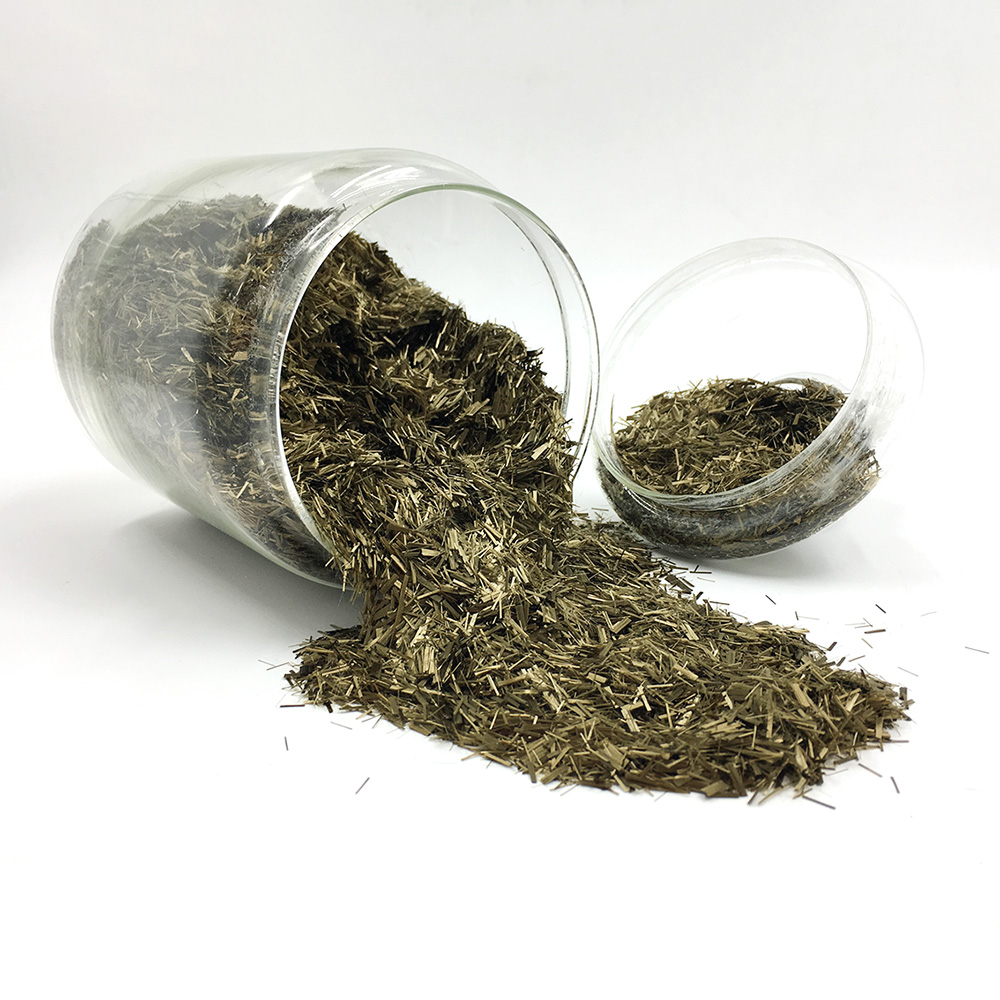
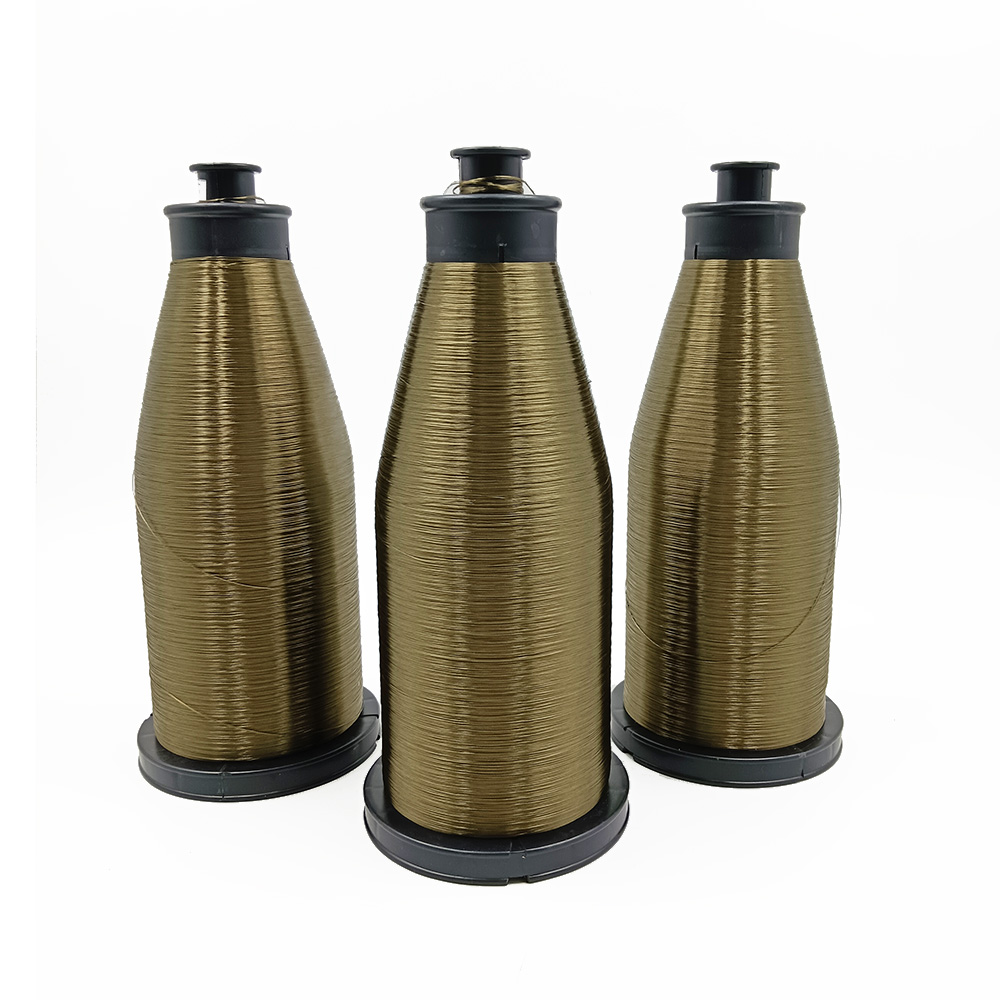
To enhance concrete's performance, fibers are typically added to improve its mechanical properties and toughness. Examples include Steel Fibers (SF), synthetic fibers (like polypropylene fibers), mineral fibers (such as basalt fibers - BF), and carbon fibers (CF). This approach has further boosted the performance of high-performance concrete (HPC) and ultra-high performance concrete (UHPC).
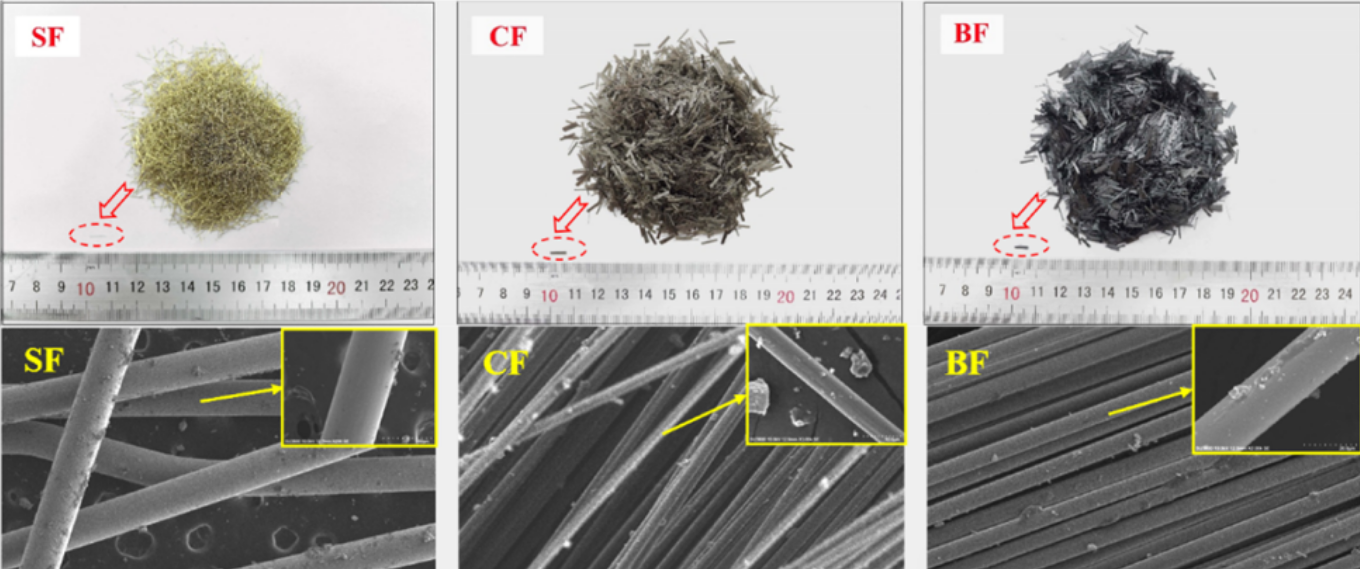
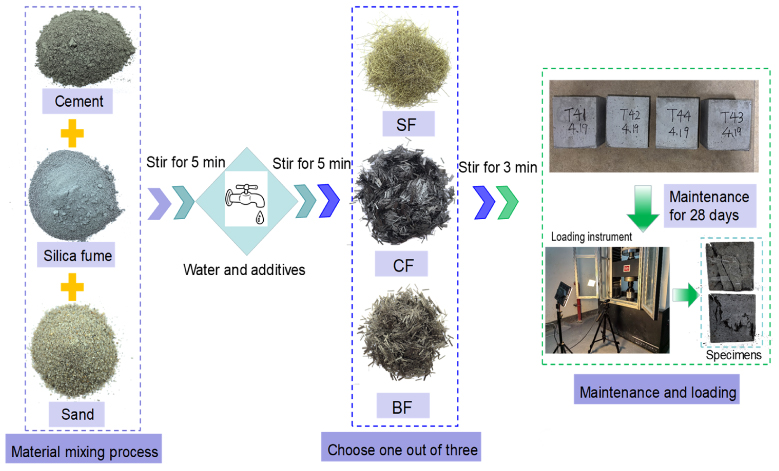
Fibers can, to some extent, improve the mechanical properties of concrete. However, different fiber types and contents inevitably lead to significant variations in their impact on concrete's mechanical properties. Currently, the optimal fiber content, the quantitative relationship between relevant parameters and mechanical properties, and the underlying mechanisms of fiber-reinforced concrete still require further clarification. This study investigated carbon fibers (CF), basalt fibers (BF), and steel fibers (SF) as research subjects, preparing concrete specimens with varying fiber contents. These fibers were chosen due to their well-documented performance enhancement in concrete and widespread application. Through controlled variable experiments, the effects of fiber type and content on the compressive strength, elastic modulus, and failure mode of concrete were systematically analyzed. Combining digital image and scanning electron microscopy (SEM) analysis techniques, the crack evolution behavior of fiber-reinforced concrete during the experiments was observed, leading to the following conclusions:
1.Compared to ordinary concrete (PC), the incorporation of steel fibers (SF), carbon fibers (CF), and basalt fibers (BF) significantly enhanced the mechanical properties of fiber-reinforced concrete (FRC) and altered its failure mode. These fibers changed the concrete's compactness and initial pore compression characteristics. As fiber content increased, the failure mode shifted from brittle to ductile. The critical transition point was 0.5% for steel fiber concrete (SFC) and 1.0% for both carbon fiber concrete (CFC) and basalt fiber concrete (BFC). To maximize mechanical performance, the optimal content for steel fibers was 2.0%, for carbon fibers 1.0%, and for basalt fibers 0.5%.
2.Although fiber content can improve the compactness and bearing capacity of concrete, excessively high content can lead to a "saturation" phenomenon, causing fiber "agglomeration." This negatively impacts the concrete's physical properties, strength, and deformation characteristics. Steel fiber concrete achieved optimal performance at a fiber volume fraction of 2.0%, while carbon fiber concrete and basalt fiber concrete reached their optimal performance at 1.0% and 0.5%, respectively. Beyond these optimal contents, performance declined.
3.Scanning Electron Microscopy (SEM) analysis revealed that the interfacial bond between fibers and the cementitious matrix significantly influences the macroscopic mechanical properties of concrete. An appropriate amount of fibers forms a dense three-dimensional network structure within the concrete, enhancing the matrix's connectivity and overall performance. However, an excessively high fiber content leads to fiber agglomeration, creating weak interfacial regions and reducing the concrete's density and strength. The changes in microstructure were highly consistent with the evolution of macroscopic mechanical properties.
4.The addition of fibers significantly altered the failure mode of concrete. Compared to plain concrete, fiber-reinforced concrete exhibited higher post-failure integrity, with fewer and narrower cracks, and enhanced toughness. Steel fibers were most effective in crack inhibition, followed by carbon fibers and basalt fibers. The "bridging effect" of fibers played a crucial role in suppressing crack propagation, while the "weak interface effect" had a negative impact on mechanical properties.