





Basalt Fiber Ushers in a New Era of High-Frequency Communication
As 5G base stations become denser, mobile phone antennas more numerous, and fiber optic cable networks more extensive, the material requirements for communication equipment are shifting from merely "adequate" to "extreme": low dielectric loss, high electromagnetic shielding, lightweight Construction, and aging resistance.
Thanks to properties such as a low dielectric constant, natural insulation, and strong weather resistance, Basalt fiber is finding its place in core components like base station antennas, optical cable strength members, and radomes. Rather than displacing existing materials, it offers a superior balance of performance and cost-effectiveness for high-frequency, high-speed applications.
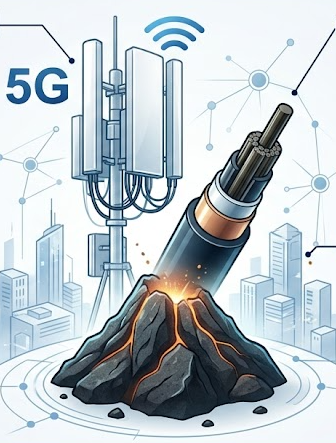
Base Station Antennas and RF Components
Antenna radomes and mounting brackets require materials with a low dielectric constant and a low loss tangent to minimize signal attenuation. While traditional fiberglass has a dielectric constant of approximately 4.8, composition-optimized basalt fiber can reduce this to 4.0–4.2, with a roughly 20% reduction in the loss tangent. In 2025, Comba Telecom (Guangzhou) Ltd. filed a patent for a "low-dielectric basalt fiber-reinforced composite radome." By utilizing specific fiber layup patterns and hollow microsphere fillers, the dielectric constant was lowered to 3.8 while impact resistance surpassed that of traditional fiberglass; the material has already undergone pilot testing in small-batch base station deployments.
Antenna reflectors require high rigidity and dimensional stability. A basalt fiber/polyurethane composite reflector, developed through a partnership between a company in Huaying, Sichuan, and Huawei, boasts a linear expansion coefficient just one-third that of aluminum alloy. It resists deformation amidst outdoor temperature fluctuations and offers a 40% reduction in weight.
Fiber Optic Cable Strength Members
The strength member within an optical cable must withstand tensile forces during both installation and operation. Traditional materials include steel wire—which is heavy and prone to corrosion—and aramid, which is expensive. Basalt fiber-reinforced plastic (BFRP) strength members have emerged as an ideal alternative. In 2025, FiberHome Telecommunication Technologies Co., Ltd. obtained a patent (CN1195123A) for a "basalt fiber optical cable reinforcement core and its manufacturing method." Utilizing a pultrusion process, the core achieves a tensile strength of 1200 MPa and a density only one-quarter that of steel wire; furthermore, its coefficient of thermal expansion matches that of the optical cable sheath, preventing micro-bending losses caused by temperature fluctuations. This product has been deployed in a transoceanic optical cable project, where replacing steel wire reduced the total cable weight by 35% and increased installation efficiency by 20%.
Yangtze Optical Fibre and Cable (YOFC) is also advancing the development of basalt fiber-reinforced optical cables. Experimental data released in early 2026 indicate that aerial optical cables using BFRP reinforcement cores exhibited an additional attenuation of less than 0.05 dB/km during thermal cycling tests ranging from -40°C to 70°C, outperforming aramid-based solutions.
Electronic Packaging and Filter Cavities
5G filters and cavities require materials with high electrical conductivity and low signal loss. While metals are traditionally used, they entail high processing precision requirements, high costs, and significant weight. Metallized basalt fiber composites offer a viable alternative to metal cavities. In 2025, Wuhan Fingu Electronic Technology Co., Ltd. filed a patent for "basalt fiber-based electromagnetic shielding composite material and its application in filters"; the process involves forming a conductive layer on the surface of basalt fiber fabric via electroless copper plating, followed by compression molding into a filter cavity. Tests show that the cavity's Q-factor in the 2.6 GHz frequency band is comparable to that of aluminum cavities, while weight is reduced by 50% and costs by approximately 30%.
Additionally, internal antenna support structures require high dielectric strength. Patents exist for composites combining basalt fiber with polytetrafluoroethylene (PTFE) to create low-dielectric-loss spacers used for isolation and support between antenna boards.
Integration of Wave-Absorbing and Wave-Transmitting Capabilities
Modern communication equipment requires components that are both wave-transmitting to allow signal passage (such as radomes) and wave-absorbing to suppress unwanted signals or clutter (such as within cavities). Through surface modification, basalt fibers can be engineered to perform both functions simultaneously. Research published in 2025 by the Shenzhen Institute of Advanced Technology (SIAT), Chinese Academy of Sciences, demonstrated the growth of nickel-cobalt nano-arrays on the surface of basalt fibers. This modification endowed the fibers with an average microwave absorption performance of 15 dB in the 8–18 GHz frequency range, while preserving their mechanical strength and low-dielectric properties. These functionalized fibers can be fabricated into microwave-absorbing patches for application on the inner walls of base station cavities, effectively suppressing harmonic interference.
Regarding integrated wave-transparent and wave-absorbing structures, a patented design utilizes a multi-layer gradient configuration: an outer layer of unmodified basalt fiber/resin (wave-transparent) and an inner layer of modified wave-absorbing fiber/resin, formed via integral compression molding. This structure simultaneously protects the antenna from environmental degradation and absorbs residual clutter within the cavity.
Practical Application Cases
1. ZTE 5G Base Station Radomes: In early 2026, ZTE announced the trial use of basalt fiber composite radomes in a 5G network deployment. Test results indicated that, compared to conventional fiberglass (FRP) radomes, signal coverage range increased by approximately 8%; furthermore, the material showed no surface chalking or degradation in dielectric properties after six months of outdoor exposure.
2. Hengtong Optic-Electric "Basalt Fiber Optical Cable": In late 2025, Hengtong Optic-Electric released an ADSS (All-Dielectric Self-Supporting) optical cable featuring a basalt fiber reinforcing core, designed for overhead power lines. Compared to conventional aramid-reinforced cables, this product offers a cost reduction of approximately 15% and a 10% increase in tensile strength; it has already won bids for power grid communication projects in multiple provinces.
3. DaFu Technology Filter Cavities: In 2025, DaFu Technology produced a small batch of basalt fiber composite filter cavities for use in a specific equipment manufacturer's 5G base stations. Customer feedback indicated a 1.2 kg reduction in the total weight of the unit and better-than-expected heat dissipation performance (achieved by enhancing the fiber's thermal conductivity through the addition of fillers).
Three Hurdles to Widespread Adoption
1. Stability of dielectric properties. Batch-to-batch variations in basalt raw materials lead to fluctuations in fiber dielectric constant (approximately ±0.2). For RF components with stringent specifications, this necessitates additional raw material screening and in-line inspection, thereby driving up costs. 2. Surface metallization process costs. Electroless copper or nickel plating on fiber surfaces—used for electromagnetic shielding cavities—incurs high processing costs, and the long-term adhesion between the coating and the resin requires further validation.
3. Long industry certification cycles. Telecommunications equipment must pass network access tests conducted by operators; any change in materials necessitates re-certification. This process can take 6 to 12 months, hindering the rapid adoption of new technologies.
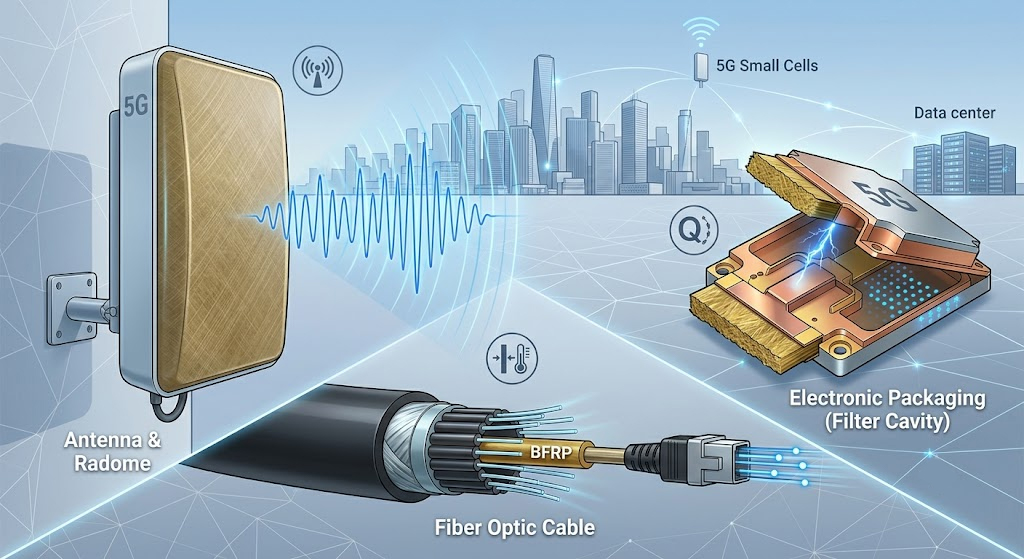
In the telecommunications equipment sector, basalt fiber is shifting from the periphery to the core. From radomes to optical cable strength members, and from filter cavities to wave-absorbing patches, it has secured a significant position in high-frequency communication infrastructure thanks to its combined advantages of low dielectric properties, lightweight nature, and weather resistance.
Three major hurdles remain: dielectric stability, metallization costs, and certification cycles. However, with the deep rollout of 5G and the initiation of 6G pre-research, the telecommunications industry’s demand for new materials is more urgent than ever. Basalt fiber has the potential to become a key material choice for enabling faster and more stable signal transmission.
Future Outlook
First, the standardization of low-dielectric basalt fiber. As 5G and 6G technologies evolve, demand is rising for fibers with a dielectric constant below 4.0 and a loss tangent below 0.005; resolving batch-to-batch consistency issues will pave the way for large-scale application.
Second, replacing existing optical cable strength members. my country’s annual demand for optical cables runs into the hundreds of millions of fiber-kilometers; BFRP (Basalt Fiber Reinforced Polymer) strength members offer clear advantages in cost, weight, and corrosion resistance, presenting immense potential for market substitution.
Third, integrated wave-transmitting and wave-absorbing structural components. Integrating the radome and the internal wave-absorbing layer into a single molded part can reduce assembly steps and lower costs, making it ideal for mass production.