








Performance Optimization and Engineering Application Research of Short-Cut Basalt Fiber-Reinforced Concrete
1.Introduction
In recent years,China's highway engineering Construction has developed rapidly, and concrete structure technology has achieved significant progress, accumulating numerous advanced and mature technical achievements. Concrete structure design has been widely applied in the field of infrastructure construction, demonstrating its importance. However, along with these achievements, the problem of concrete cracking is becoming increasingly prominent. The presence of cracks compromises the performance of concrete, notably reducing its tensile strength, which is the primary reason for the brittle failure exhibited by concrete. Short-cut basalt fiber, as a novel fiber material, has become an excellent concrete reinforcement material due to its unique mechanical properties, good stability, and high cost-effectiveness.This article will focus on the characteristics of short-cut Basalt Fiber and explore its practical application in concrete reinforcement and strengthening.
2. Properties of Short-Cut Basalt Fiber
2.1 Definition
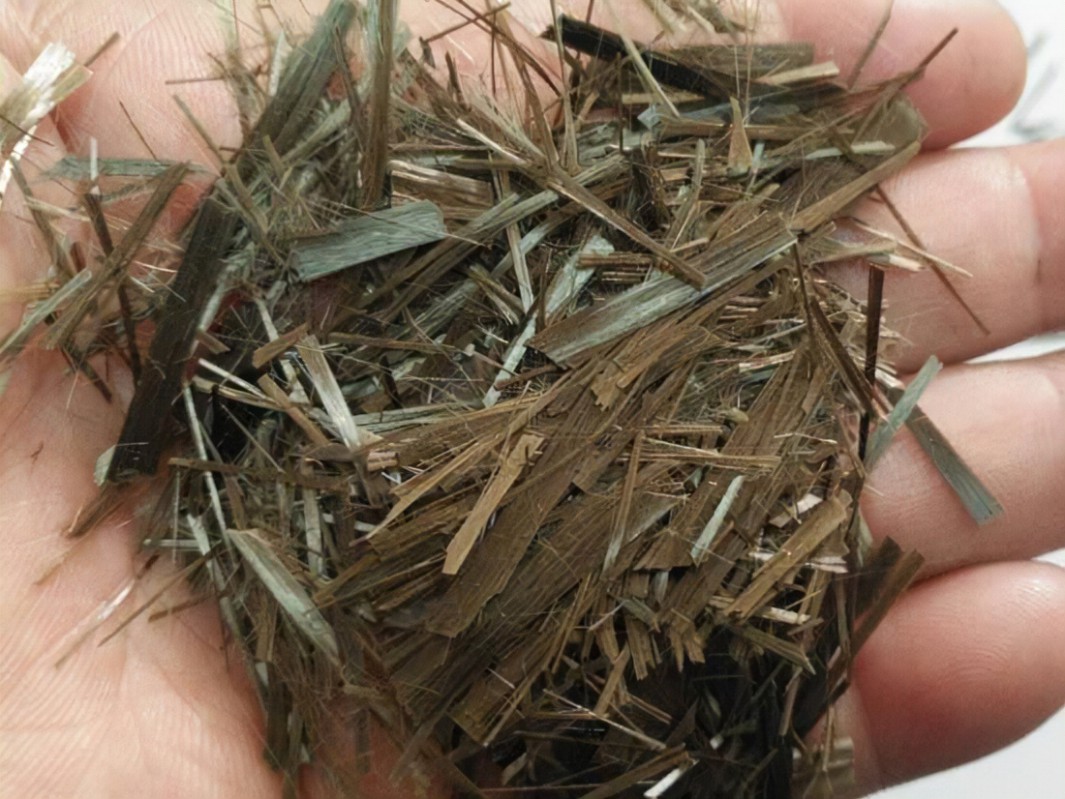
basalt fiber is an inorganic mineral fiber that is processed by cutting continuous basalt fiber into lengths typically less than . It can be uniformly dispersed within concrete. According to its application, it can be mainly classified into: anti-cracking fiber for concrete (), toughening and strengthening fiber for concrete (), and anti-cracking fiber for mortar (), among others.
2.2 Performance of Short-Cut Basalt Fiber
Short-cut basalt fiber possesses excellent properties of high strength and high modulus. Its tensile strength can reach , and its elastic modulus is no less than . Its high-temperature resistance is outstanding, allowing it to work continuously within a wide temperature range of to . It exhibits high corrosion resistance and chemical stability in corrosive media such as acids, alkalis, and salts. Particularly in alkaline media like saturated alkali solution and cement, its single-filament fracture strength retention rate is greater than , demonstrating excellent resistance to alkali corrosion. Short-cut basalt fiber has good compatibility with inorganic binders, a moisture absorption rate lower than , and its hygroscopicity does not change over time. This proves its good material stability, long lifespan, and environmental compatibility during use. Furthermore, this fiber also has excellent characteristics such as insulation, high-temperature filtration, radiation resistance, and wave-transmitting capability. Its performance indices are shown in Table 1.
3. Application Analysis of Short-Cut Basalt Fiber in Concrete
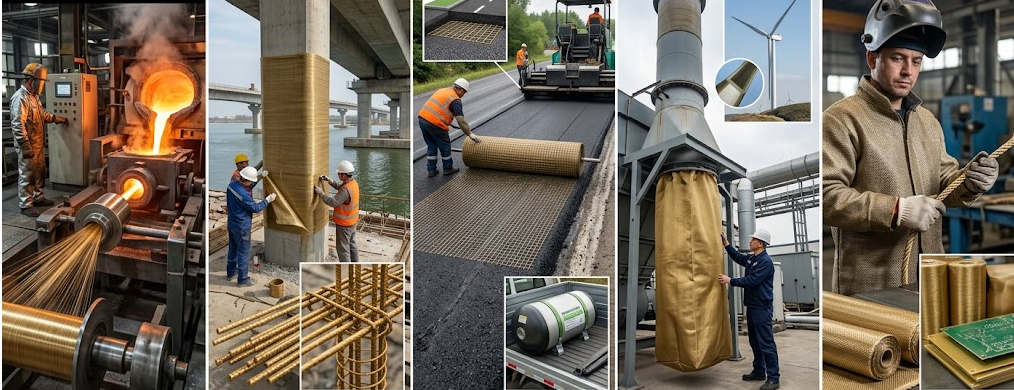
Short-cut basalt fiber reinforced concrete involves incorporating a certain amount of continuous or discontinuous short-cut basalt fiber into the concrete in an appropriate manner. While retaining the original advantage of concrete's compressive strength, this method can significantly improve its toughness and tensile strength, thereby effectively reinforcing and strengthening the concrete and extending the service life of the engineering structure.
In addition to basalt fiber, carbon fiber, glass fiber, aramid fiber, and others have also been used as reinforcing materials in concrete. However, long-term practice shows that these materials present certain issues when applied to concrete, making it difficult to meet market demand for high-performance concrete. The emergence of short-cut basalt fiber fills this gap in materials and methods, greatly promoting the development of concrete strengthening and reinforcement technology. Its role in concrete reinforcement and strengthening is mainly reflected in the following aspects:
-
Effective Crack Inhibition: Due to its quantity and surface area advantages, short-cut basalt fiber can effectively restrain micro-cracks, preventing their connection and expansion. Meanwhile, it overcomes the disadvantages of other synthetic fibers, such as low density, low tensile strength, and low elastic modulus. It is not easily pulled apart during crack propagation, which can significantly inhibit the development of micro-cracks and delay the generation of new cracks, positively affecting the improvement of concrete's permeability and freeze-thaw resistance.
-
Combines High Modulus with Construction Convenience: Short-cut basalt fiber not only leverages advantages similar to steel fiber's high modulus and high single-filament tensile strength to inhibit crack expansion, but also effectively overcomes the drawbacks of steel fiber, such as easy clumping during mixing and difficulty with pumping and construction.
-
Good Dispersibility and Compatibility: As a silicate-based inorganic fiber, short-cut basalt fiber has natural compatibility with cementitious materials. Its density (approx. ) is close to that of cement concrete and mortar, resulting in good workability. Once added, it can disperse uniformly throughout the concrete structure.
-
Excellent Durability: Surface-modified short-cut basalt fiber exhibits "inert fiber" characteristics, demonstrating outstanding resistance to high temperatures, corrosion, and impact. It maintains stability even in high-temperature and highly corrosive environments, and it can enhance the deformation resistance of the cement matrix. Therefore, it can adapt to the rigorous environments of the concrete mixing, pouring, setting, and service stages, significantly improving the durability of the concrete.
In summary, short-cut basalt fiber can effectively improve the impact resistance of concrete, reduce its brittleness, and comprehensively enhance its mechanical properties. Specifically, it functions in concrete structures to inhibit cracking, prevent seepage, enhance durability, improve impact and tensile capacity, and help improve surface quality.

4. Construction Methods and Precautions for Short-Cut Basalt Fiber Concrete
4.1 Construction Temperature
Short-cut basalt fiber concrete should be constructed at temperatures between and . Temperatures that are too high or too low may lead to non-uniformity of the mixture.
4.2 Construction Quality Control
Quality control for short-cut basalt fiber concrete construction should focus on raw material inspection, metering accuracy, and the quality of the mixing procedure.
4.2.1 Mix Proportion Design
In actual construction, different short-cut basalt fiber dosages should be selected within a reasonable range based on project requirements. Since short-cut basalt fiber itself does not chemically react with other concrete components or admixtures, its dosage typically does not alter the original concrete mix proportion design principles. During construction, the quality of all materials must be strictly determined according to the construction mix proportion and the batch quantity for a single mix. Table 2 provides an example of the optimal mix proportion for basalt fiber reinforced concrete.
Tests have shown that a higher fiber dosage does not necessarily result in better crack resistance. When the dosage does not exceed , the compressive strength of the concrete shows a trend of initial increase followed by a decrease (exhibiting a peak value) as the fiber dosage increases.
4.2.2 Feeding Sequence and Method
During the mixing process, short-cut basalt fiber should be added simultaneously with aggregates such as sand and stone. It is recommended to sprinkle the fiber uniformly into the sand and stone during their placement, and then add water for wet mixing.
Fiber addition methods can be divided into manual and automatic feeding:
-
Manual Feeding: The weighed basalt fiber is manually added after the hot aggregate is placed into the mixer. This method involves high labor intensity, relatively lower mixing uniformity, and requires an appropriate extension of the mixing time to ensure uniform fiber dispersion.
-
Automatic Feeding: An automatic basalt fiber dosing machine is used for automated metering and simultaneous addition with the mixer's hot aggregate. The fiber dosing machine is usually equipped with automatic metering, pre-dispersing, and pneumatic conveying mechanisms, offering the advantages of convenient, fast, and accurate addition. The appropriate method should be chosen based on the construction conditions.
4.2.3 Slump Adjustment
The addition of fiber slightly increases the viscosity of the concrete mixture, which affects the slump. If the slump does not meet construction requirements, a plasticizer or water-reducing agent should be preferentially used for adjustment. The issue should not be resolved by increasing the water content.
4.2.4 Forming and Curing
No special requirements exist for the forming of concrete mixed with short-cut basalt fiber, but sufficient vibration and compaction must be ensured. Its curing requirements are the same as those for ordinary concrete.
Brief Application Case of Short-Cut Basalt Fiber Concrete
The Jing-Zhu Expressway (Anyang to Xinxiang section) is a national trunk highway and a vital part of Henan Province's expressway network. Due to the high embankment fill and poor subgrade soil quality in this section, subgrade uneven settlement and other defects appeared soon after its opening. In recent years, with the surge in traffic volume and the increase in overloaded vehicles, the pavement has repeatedly suffered from various defects such as longitudinal and transverse cracks, potholes, settlement, grid cracking, and alligator cracking. This not only seriously threatens driving safety but also poses great difficulty for daily maintenance. Furthermore, the original four-lane design has long failed to meet transportation demands, necessitating expansion and reconstruction.
Short-cut basalt fiber concrete was applied in the subgrade filling of this project. Practice has shown that its tensile strength increased by over , its fatigue resistance improved by over , and its rutting resistance increased by over . It has shown significant effectiveness in preventing longitudinal cracks, inhibiting crack expansion, and extending the service life of the pavement.
With its unique mechanical properties, excellent stability, and high cost-effectiveness, short-cut basalt fiber has become an efficient concrete reinforcement material. The application prospects for short-cut basalt fiber concrete are extremely broad. Its significant advantages in enhancing engineering performance and extending service life are expected to yield good economic and social benefits, positioning it as an important construction material in the field of civil engineering in the future.